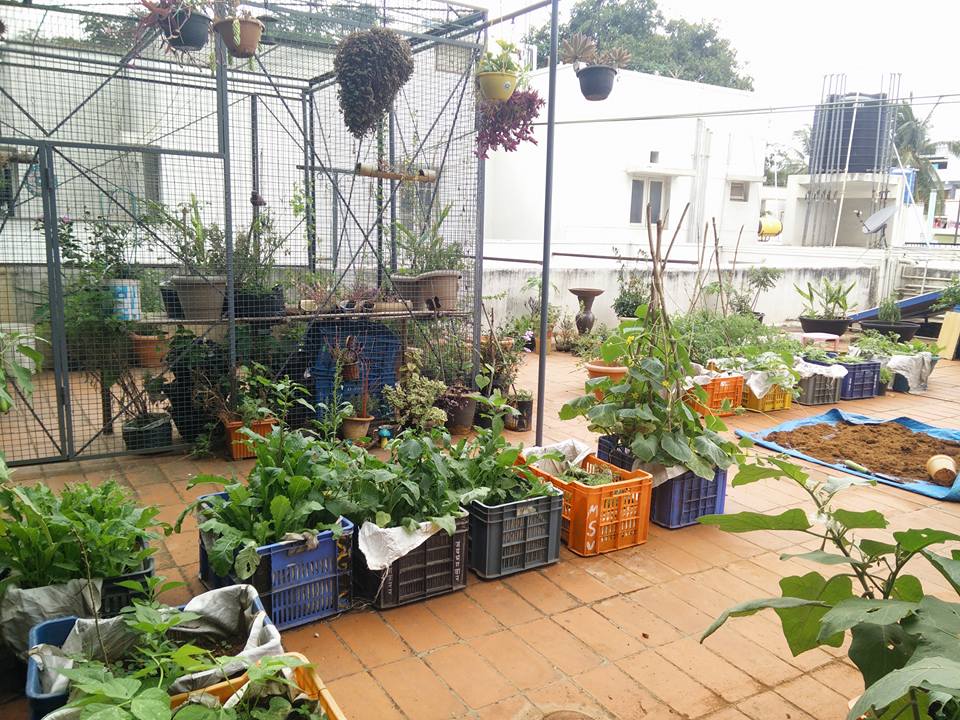
Whenever the summer sets in, the plants need extra care as they could get burnt due to extreme sunlight or they get dehydrated.
Proactiveness
We can start planning this even before the summer season comes in.
Mulch, Mulch, Mulch!
The nature's work is so well planned, but we often fail to notice!
Before the summer, the nature has scheduled "the leaf shedding" season. We let the fallen dried leaves been swept away by the BBMP staff. However did you know you could use them to mulch the plants? The term "Mulching" may sound a fancy, but it just means to cover the topsoil with dried leaves, so that the water does not evaporate.
So start collecting these dry leaves during the shedding in gunny bags!
This is THE BEST option that would work. You could also mulch with sugarcane pith or coconut husk if available.
On a side note, did you know you could also compost these dry leaves if you have in excess? Click here to read about it.
Mulching
Cocopeat
Usage of cocopeat in your potting mix retains the moisture and also keeps the soil loose for the roots to grow well. Ensure it does not exceed the 1:1:1 ratio of redsoil:compost:cocopeat for veggies and 1:1:1/2 for the greens, else they could rot.
Cocopeat
(Pic Source : Internet)
Re-use and recycle water
If you have the rainwater harvesting in place, it would be the best.
Now a days people are also looking at re-using the water from kitchen and RO water purifiers for the plants and some even from the bathroom! But the last option would need some water treatment.
Reuse the water with which you wash the rice and dal.
Ensure you are not using chemicals for cleaning purpose. Use bio enzyme or soapnut liquid for cleaning utensils and sink.
Water treatment can be installed at home; watch the below video as an example.
Shade Nets
These are also an option. There are various types of shade nets. When S.V. Hittalmani (Additional director, department of horticulture, Government of Karnataka) visited my terrace garden to give me tips on growing edibles, he suggested that the shade nets with 30-40% density are ideal for Bangalore weather. Lesser than that, the plants may still burn. More than that, the plants might not get good sunlight, which would affect the growth of the plants.
Shadenet
(btw, this pic was taken in the year 2014. Now my garden is nothing like this! :-D Felt nice to come across this pic!)
Drip Irrigation
Even after following the above (some/all) steps, the option is to water the plants twice a day. If you cannot make that additional time in the evening due to working hours, and if you have the budget, you could setup a drip irrigation system. There are many variants and now with the help of technology, we can even automate the schedule. See here to know more about the options to setup the drip.
During Summer, Save Water and Retain your plants too!
The main goal is to keep the soil moist during summer and also to save water. Using the above methods, we not only avoid quick evaporation of water in summer, but also save the water by not watering the plants twice/thrice a day.
Pic Source : ken-foundation
Let us do our bit - choose the method that suits your lifestyle!
[If you wish to contribute other methods which is not mentioned in this post, please feel free to leave a comment for it to be included. TIA!]
Whatever we buy from the stores (be it clothes , groceries, household items, just anything), we always go on the brand name, trust the brand blindly and buy - this is the normal human tendency.
Since food is so important (it is something we consume internally and not wear externally) - have we ever given a thought as to from where does the veggie vendor source all the veggies that you buy? You may say - "From the market?" okay... but from where before that? The sad truth is no one knows the answer, including me.
We are clueless as to what are we eating and from where!
Take a look at the videos here and here and here to see how clueless we are on what all the veggies undergo before it reaches us.
Direct deals with farmers
Did we ever realize that the most important job on earth is of a FARMER than anything else in this world?
More than anything else, it is the food because of which we are alive, because of which we are able to go for work, because of which we are living our families happily.
Over the times, we have taken food for granted. We don't realize that there should be some person (farmer) physically standing, sowing seeds, taking care of them, harvesting them for it to reach us one day. And that is a job which has been taken for granted.
What if the farmers stop growing food? Where do we get the food supply from? Did you know even if we want to grow it ourselves, each crop would take 30-60 days or even more for us to get one batch of crop? How can we live without food? (It is not just vegetables and fruits; it includes even the grains like rice, dal, wheat etc)
Nowadays it is a huge question mark for the Indian urbanears as to why are so many farmers are committing suicide. It is because they are in debt and in no way can repay what they have spent. How can any human (not only farmer) repay their debt if this is what (below bill) they are paid in return for their crop?
You may wonder that even though you would have spent so much on the veggies and fruits, where did all that money go? The truth is most of it is going to the middlemen and transportation from one city to another and not even reaching the farmer, who is the sole reason for us to eat what we got from the shop.
Looking at the current trend, farmers are discouraged and you can take a guess that none of their family members would continue farming. Who would supply the food for us then? We will start importing the food and that is going to cost our money (in the form of tax again in the next year's budget)
Knowing these problems (and there may be other unknown/hidden problems as well) to create a win-win situation, for us - the consumers and the farmers, the best model would be to buy directly from the farmer.
With direct buying from the farmers :
You buy FRESH food, it is not preserved in cold storage and does not have to deal with all the dust from various cities.
You are sure from where you have sourced it.
It is even better if you find out that they have an Organic Farm - we can see the site they grow the food on, we can trust the farmer that he is maintaining the farm organically.
The money you spend decreases (as there are no/less middlemen involved)
The farmer can earn what he deserves for his hardwork - he gets justice, and hence indirectly we (consumers) are saved.
How to find out Local Sources
A few start up's have come up with this model of creating a win-win situation. Here are few ones which I am aware of. If you know if some more, please feel free to convey it as a comment and I shall add these up to benefit the others,reading the blog.
[Disclaimer : Try finding a local farmer yourself within your area; Speak to them and confirm if they are organic or not, if you are very particular for it to be organic]
Everybody would have heard this a million times. But have we REALLY given it a thought? Why do we, specially educated people do this? Is it because of the ease of not requiring to carrying bags? Look what we so called "educated" people are upto! We see the below state of the city almost in every street, yet do not bother, thinking it is BBMP's work and they are not doing it.
Streets piling up with plastic covers - is so alarming !!!
Until the BBMP picks them up, many cattles come and feed here, consuming plastic covers. So what? It is from this cow, you will get the milk and consume it yourself. And that cattle dies eventually due to KG's of plastic covers in it's stomach.
Remember - "What goes around, comes around!" Yes, this is THE RULE nature follows.
Pic Source : Internet
Pic Source : Internet
Even though BBMP takes it away from this spot, the maximum they could do is dump it to the landfills. What happens there? Has anyone given it a thought?
Trucks to dump the waste we generate in landfills - Pic Source : Internet
Can you imagine the smell this generates in this area? Pic Source : Internet
These landfills will have these for centuries together, as the plastic is NOT decomposable. So what?
If pictures are not convincing enough, take a look at the vidoes showing what is happening in the landfills -
(Video Source : Deccan Herald)
(Video Source : Deccan Herald)
After looking at these video, what is the feeling we get if we are real, educated human beings? It should be "the guilt".
Oh please, let us stop blaming someone else for the things we are responsible for! Look what have we been doing to the Nature all these years. It is high time, we REFUSE plastic covers at the first point.
Also a reminder that Plastic Covers are very much REUSABLE. We all understand that it is not practical to use cloth bag every time, but we can ALWAYS REUSE these plastic bags already at home!
Since cleaning begins at "home" we, volunteers of South Bangalore Organic Gardening, (group named The SOUTHekais) planned and set out to make the "Refuse/Reuse Plastic Covers" Drive on 6th Dec 2015 near the Mini Forest Park, where we see roadside veggie vendors selling on daily basis and their customers are mostly the morning walkers, who after a stroll in the park, take back the veggies home on daily basis, also taking back NEW plastic covers every single day (a regular pattern as observed in any area probably)
The target was to spread awareness on this among:
The roadside veggie vendors
Their customers, who EACH time took a new cover every day.
So ,we prepared ourselves with a few banners on what we want to convey, a table, few cloth bags, compost bins for demo (an additional msg to re-use the kitchen waste) and setup a stall on the road side by 7am.
Pic Source : TSK
Looking at the new faces, people started getting curious or probably wondered if we are new veggie vendors in the area :-P
At first, they were hesitant and were scared to pass near to our stall. We welcomed each passer by, who looked at us and few were courageous enough ( :-P ) to ask what were we upto!
While we observed the vendors who were giving away plastic bags and also observed the walkers, who carried plastic bags and then and there started conveying and they said "sure, we know... but still..." , we also saw a set of people carrying their own cloth/jute bags. We clapped in group for them and thanked them for carrying their own bags and they felt proud, smiled back and said "Yes, we understand and we practice it" !
Those who were curious about the bins labelled as "Demo Bokashi Bins" and the tiny Khamba, came nearer to ask what was that about and we gave various details about - what is composting, different types of composting and how easily we can do it either via a DIY way at home or buy readily available stuffs from Vendors.
We also informed them about how harmful is using disposable containers - the paper cups (which is wax coated and contains a plastic layer in between), the disposable plates which contains harmful chemicals , which when used on a longer period of time, can cause harm.
Milkman - encourages bringing own bags
A silent crusader, the milkman as we saw, did not give away plastic bags so easily. He asked if the customer has brought his bag. Proud to have such informed people around!
The "technique" of folding a Plastic Bag
Well, it is not a robotic science :-D , but this triangular fold definitely works like a charm! And then you could put them in your vanity bags, laptop bags, car, scooter, or even your pocket!
Video
Overall Experience
By the time the TSK team wrapped up by 9am, we had the sense of immense happiness that people actually wanted to know (about composting), but did not know where to gather the information from; that people agreed on re-using plastic covers; that people actually showed their interest in growing veggies organically at their home!
It is just the beginning and we have more such campaigns planned up! And yes, we are volunteers and do this for FREE :) We would like to encourage every individual to contribute in below ways :
Reuse plastic covers. Refuse new ones.
Spread awareness among your family, friends whenever you see them asking for a new plastic cover or not carrying their own bags, when they very much know that they are out for shopping.
Cleaning Agents = Lot of non-biodegradable chemicals
The commercially bought cleaning agents (Bathroom cleaners, Floor Cleaners, Soaps and Detergents and likewise) are so powerful and strong. Have we ever wondered how much of chemicals are going into making them? Are they bio degradable?
Pic Source : Internet
Pic Source : Internet
Pic Source : Internet
While a few category of biodegradable cleaning agents are available in the market, you could make them on your own at home using citrus peels, thus reducing the landfill, reducing the water pollution made from chemically made detergents - basically reusing and utilize what is given to us by nature.
What is Bio Enzyme
We all might already know the power of Lemon as a Cleaning Agent, used in day to basis. The good news is that, even the peels of the citrus category fruits could be used as cleaning agents!
How to make Bio Enzyme
Ingredients
Citrus Peels (Lemon, Orange, Mosombi and likewise)
Jaggery
Water
A 25 ltr bucket with a lid (to make about 10 ltr of bio enzyme). You could also make it in a 1 ltr bottle to start off with. Adjust the ratio accordingly.
Method Of Preparation
We had made juice out of 2 KG mosambi and hence you can imagine the quantity of the peels. You could add any citrus peels together for this solution. Remove the pulp and clean the peels as shown in the pic below
Take approx 10 ltr of water and soak the peels as shown below. I tore the peels further - smaller pieces, faster the decomposition.
Add about 1/2 KG Jaggery to begin with. You could keep adding a handful of jaggery if required on fortnight basis if you see white worms sitting on the inside of the lid. Close the lid and keep it aside (away from direct sunlight and outdoors to avoid any foul smell)
NOTE
If you are using 1 ltr bottle, do NOT close the cap tightly. Leave a gap open for the gases to escape. Otherwise the bottle could bulge and burst when you try to open it the next time. Shake the bottle once in 2-3 days to give it a nice mix.
Keep stirring the solution once in 7-10 days and keep a check on white worms. The peels will start to break down soon and you could see them as settling at the bottom of the bucket as sediment. It would looks like the below pic after 2 months.
This is how it looks after 3 months - light yellow liquid, which could be used a floor cleaner, utensil cleaner, bathroom cleaner, glass cleaner. The expected smell should be of fermented citrus.
Usage
Dilute it or use it as concentrated, as you use other cleaning agents.
Troubleshooting
If you see it getting smelly, add more Jaggery and stir the solution.
If you feel that it is stinking a lot and is unbearable, just pour in down the drain, it will clean up your drain.
You could consider Drip Irrigation to be installed for your garden, if :
You are elderly/senior citizen and cannot physically lift / move the heavy/tangled hose pipes.
You do not have a gardener, or you do not like to depend on someone to water your plants.
You are a busy person, but still love to maintain a garden at home.
You are regularly away from home for days together/ travel a lot from office, which is stopping you to own a garden.
You have health issues, which does not allow you to lift weights or climb the stairs on daily basis.
You love to have a garden, but you are lazy by nature and don't want too much work on your hands.
Whatever may be your reason, our aim is to let the plants keep growing and these reasons not to stop you from having a home kitchen garden.
Does it decrease the "closeness" you have with your garden?
You may argue that we feel closer to nature when we water the plants on our own, because we get to spend the time there physically, it is a form of exercise and the best way to get fresh oxygen early in the morning (Believe me, I said the same too earlier to others), but at the same time, thinking practically, I did not want to stop gardening nor wanted to depend on someone to water my plants because I could not on few days, nor I could see my plants die!
Why did I go for a Drip Irrigation System?
I am a working person, and recently got additional responsibilities and change in job role and on it, I indulge in multiple extra activities (my 1 hour exercise routine, yoga classes, bag making, quilt making, kitchen gardening, giving workshops on composting, cooking, and also cleaning the house now and then - I am sure I have OCD by now :-P ) and over the period of 2 years of starting my garden, balancing all of them got challenging, which showed up on my health (back ache) and eventually on my "once upon a time" beautiful garden! :-(
I enjoyed gardening because gardening was one of the best stress buster for an overly active person as me. I loved observing the plants, touching them, talking to them, watering them; I started off with water cans due to the small number of pots and when they increased, moved to garden hose.
My kitchen garden is on the 2nd floor, I would go twice a day to water them during peak summer time, as the plants would all wither off due to the extreme sun. I never believed in getting drip irrigation for my garden, until a stage came when I could not climb the stairs due to the back ache and when I was getting better after 2 weeks, I was in shock (I was hoping the Rain God would have saved them) to see all of my plants had died. It was so so disappointing to see. I was mourning on this incident for about a week and realized that now that I have come till here in my kitchen garden journey, I cannot stop growing further, so take an action to rectify this!
My garden pic, BEFORE the crises
Harvests before crises
My garden pics, AFTER the crises
Once a gardener, always a gardener
I realized that gardening has reached so deep into my cells! My friends too started asking as to why my posts in the OTG group has decreased in recent times. I was silent there, because I did not have anything to show, which made me feel so bad.
Water is an important and essential ingredient for the plants and I could not always pray for the Rain God to shower blessings in my difficult times of unable to water them. I immediately started researching the options on Drip Irrigation, as now I started looking at this concept as an investment, than a "Fisool Kharch" (unnecessary spending) and that would steal me away from my garden.
Not just a normal drip, but a "smart" drip
With the technology growing, we are lucky to have some things that ease our life.
This concept did not just have the normal water drip setup, but there were additional options to :
Schedule the watering via mobile phone (with wifi enabled smart plug).
Modify or add a new schedule in the app.
No worries even if you do not have a smart phone for apps - they have an additional plug with buttons to schedule.
I could now add the organic liquid fertilizers (Panchagavya, Bokashi Leachate, Jeevamruth etc) into the 100 ltr blue drum that comes along the installation, which would take care of supplying it to all my plants. I need not spray it with my effort of manually pumping the water sprayer to all the 100 plants. (think of the amount of time and lifting I would be saving)
I could now travel out of station for days, without worrying of what would happen to my plants as it is scheduled and it will turn ON and OFF automatically without my interaction.
Oh and it is not just the drip nozzel, we also had the option to use sprinklers and seperators (specially useful for greens and wider containers where the normal drip would not reach all the seeds)
One of the best thing is that we need not invest on this at the same time, we could keep extending it when required so that your don't feel burdened about $$ at the same time.
Now I will also be accountable for the amount of water I would be using for my garden and simply do not let it go waste by over-watering.
Pics of the setup
The blue drum, where I can just pour the organic liquid fertilizers, which will be carried to all the plants.
Water would be filtered from the tap and led to the drum
The ballcock, to prevent water overflowing from the drum. I could directly pour the organic liquid fertilizer into this drum.
I cant wait to try my hands on giving liquid fertilizers to my plants this way!
The "Smart Plug" which is wifi enabled and is scheduled via app. I just have to keep it switched ON and do nothing more.
The schedule on the App on Android Phone, which can be modified anytime.
The sprinklers for wider containers
Sprinkler for wider containers
Am I separating myself from the garden by introducing this stuff?
No , this does not mean that I will not be visiting my garden any more. I still have to de-weed, check on the pests, prune, and also click pictures and upload to OTG group right? ;-)
Now I can concentrate more on improving my back and deal with other things in life and at the same time, not feel guilty of stopping my OTG obsession. I now feel confident about my garden and I wish to see my garden flourish once more like before!
Wish me luck guys :-)
I wish to see my garden flourish once more like before!
DIY Setup
Of course, if you have the patience, time and skills, you could always go the DIY way to reduce the cost.
While researching, I found that a DIY kit is available here.
If you reside in Bangalore, a good place to get the products separately for a cheaper price would be SP Road.
Considerations for drip to reach from point A to Z
The reach of water depends on
1. height of the tank
2. water motor's power
3. the elevation of the ground on which the pipes would lie.
4. other types of outlets attached than normal drip (example sprinkler,emitter)
Drip recommended for greens
A normal drip might not reach all the greens in the potting mix. Specially during germination time.
Ensure your potting mix contains porous material (cocopeat or fine compost) so that it retains water and spreads it to other parts of the pot.
As an alternate, you could use a SPRINKLER or an EMITTER for this purpose. Check below videos to see how it works :
Drip irrigation - recommended SPRINKLER for greens (on OTG)
Drip irrigation - recommended EMITTER for greens (on OTG)
However note that when these sprinklers and emitters are used, the power of water to reach further decreases. So, ensure you have a powerful motor (power depends on the length of pipe, elevation etc again) or install a seperate pipe for emitters/sprinklers.
Disclaimer : There are multiple drip irrigation vendors in the market. If you would like to go the DIY way, the information is above. Also Checkout OTG Commercial Posting page, here and here. I got it done by Smart Gardens ; Their contact details are here.